

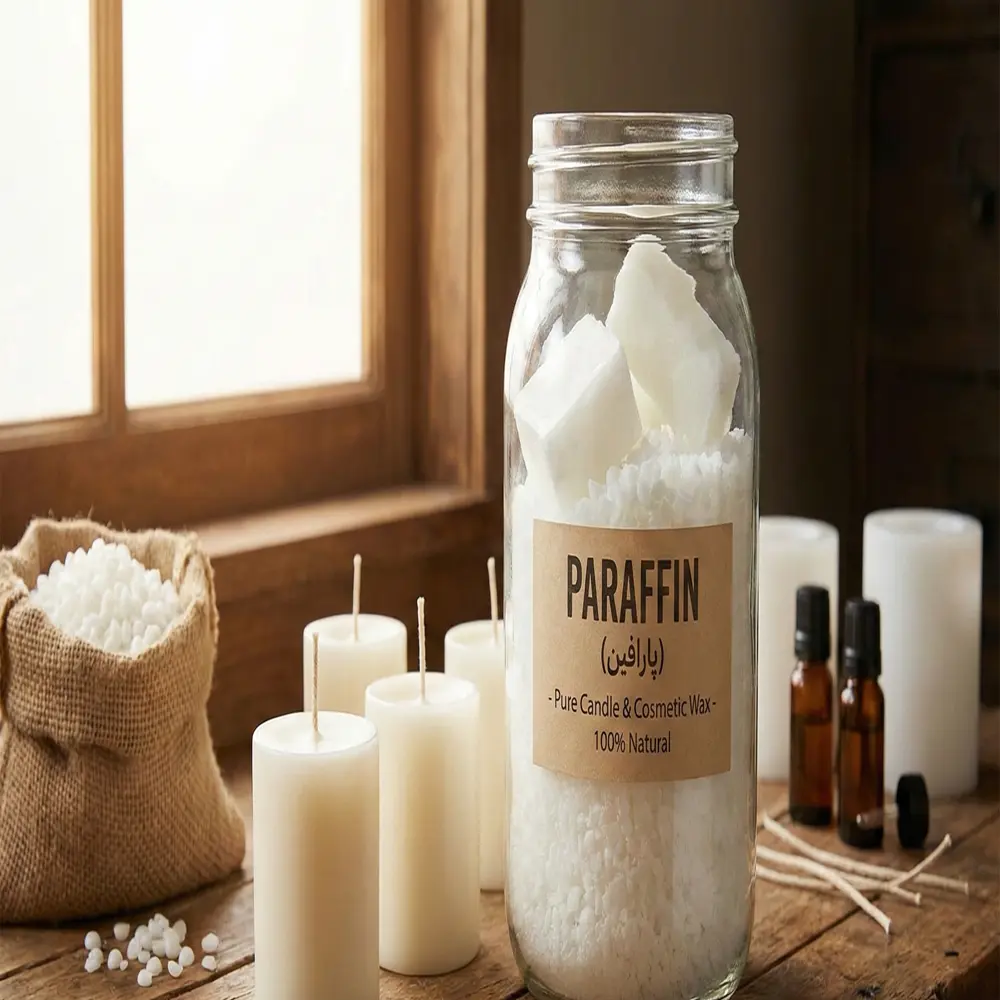
Paraffin It is one of the most important petroleum derivatives that Crude oil refining It is obtained and in the form Solid (paraffin wax) Or Liquid (liquid paraffin/paraffin oil) It is used in various industries. This material belongs to the family Saturated hydrocarbons (alkanes) It was and because High chemical stability, odorlessness and good safetyIt has wide application.
Types of paraffin
Paraffin is divided into several main categories based on its physical state and degree of refinement:
| Paraffin type | Physical condition | Indicator feature |
|---|---|---|
| Solid paraffin | solid | Specific melting point, malleable |
| Liquid paraffin | Clear liquid | Odorless, stable, safe |
| Microcrystalline | Semi-soft solid | High flexibility |
Technical specifications of solid paraffin
| Parameter | Usual amount |
|---|---|
| Melting point | 46 – 68°C |
| Oil percentage | Less than 1% |
| Color | White to cream |
| b | Almost odorless |
Technical specifications of liquid paraffin
| Parameter | Usual amount |
|---|---|
| Density at 15°C | 0.82 – 0.88 g/cm³ |
| Viscosity | Variable (light to heavy) |
| Smell and taste | Odorless and tasteless |
Paraffin applications
🔹 Candle making industries
-
Main material of production Types of decorative and industrial candles
🔹 Cosmetics and health industries
-
Base in Creams, ointments, and skin care products
-
Retains moisture and creates a protective layer
🔹 Pharmaceutical industries
-
Use of Pharmaceutical liquid paraffin As a lubricant and carrier
🔹 Food industry
-
Coating of fruits and edible products (food grade)
🔹 Packaging and match industries
-
Waterproofing paper and cardboard
-
Match production
Benefits of paraffin
-
High chemical stability
-
Odorless and colorless
-
Safe in health and pharmaceutical grades
-
Reasonable price
-
Variation in grade and melting point